

Close your eyes. Inhale and picture a space. What do you see? With the swift swipe of your phantom finger, you strip away the walls, the floorboards, and knock down the building blocks. Watch as they topple over one another as the foundations of this space are undone. Debris pushed aside, you cup the soil to disinter a pit of pipes. Now, open your eyes. Exhale. Just as one meditates to gradually unblock chakras - for artist, writer, and architectural designer Teshome Douglas-Campbell, the considerations for space and structure are soul deep.
As an intersectional feminist architect, Teshome’s architectural practice explores the urban democratisation of wellbeing and mindfulness, questioning how a space - through its design, inhabitants and commodification - influences our sense of access. Heeding to the domestic, Teshome’s practice interrogates the history of architectural design itself, the hegemony of white cis-architecture spurred on by gentrification, and the absence of culture-led, accessible spaces designed by and for marginalised/minority communities.
Deepening his exploration of architectural design, Teshome is part of the architectural collective ‘Patch’, cultivating spaces for community-based initiatives dedicated to the diasporic concept of home.
The Poorly Project visited Teshome’s community pottery studio in Roman Road to discuss how his practice dispels contemporary city-born hysteria, decoding its approach to wellbeing, and building the constituents for more inclusive and mindful architectural design.
The architect. The master builder. He who commands through slab and stone - the ancient Grecian etymology for the architect appears to make no room for renovation. Artist, writer, and architectural designer Teshome Douglas-Campbell refutes this - for the future of contemporary architecture is one being actively led by intersectional feminism and a keen eye for inclusivity and accessibility.
Teshome’s architectural practice serves as a patron to the diasporic and low-income communities at risk of gentrification. Growing up in Hackney, he became an early witness to the displacement of his local community, racial and cultural hostility, and socio-economic infringements on wellbeing. It meant that generosity would become an immovable element in his practice.
“I think there's a lot of resentment within the black community within these spaces, which are now trendy. I think that resentment has health implications” comments Teshome.
“Gentrification is a process of extraction. Whereas immigration is a process of contribution. Those are fundamental differences to be aware of”
“I think there's also a question on who can occupy a space without being harassed- those weird inequalities mean that people feel like they have to stay within a small radius, and they don't feel comfortable leaving. To be able to leave without being corralled or harassed is a fundamental right, especially if you're not doing anything illegal”
Autonomy and intersectional assertions of power are endangered by the seemingly revamped. Spaces and structures demolished and built by force now offer lifestyles and cultures that fail to acknowledge and house those they have borrowed from or been influenced by. For Teshome, gentrification poses a threat to communal and cultural well-being. Where culture was once rooted and prospered in safety and support, it now remains a crater.
“One's local area is home to a whole host of networks. And many of those networks are in the service of wellbeing. With erasure, all these informal settlements of domesticity outside your house begin to disappear”
“When you're walking through a space, there's extraction in some way on every corner. It's void of any culture or authenticity. There's nothing new being made”
“There's an important distinction in terms of making sure these things are for the community or a reference to the community”
Apposite to gentrification, Teshome investigates the condition of spaces and structures left as afterthoughts or built upon demand, the political nature of architecture, and the performativeness of civic care. Reaffirmed by his intersectional feminist approach, Teshome probes into the institutionalised, unseen, or indiscernible hostilities of architectural design, where the architectural metrics are determined by and centered around the white, able-bodied, heteronormative view.
In 2022, Teshome would board a flight to Jamaica with the hope of initiating the community project known as TRIBE Meditation Retreat (2022 - present). Concentrated on developing a structure where rest and wakefulness are uninterrupted states of peace, TRIBE is dedicated to young black men combating the hysteria and violence of growing up in London.
Understanding the healing value and inimitable quality of nature, Teshome would harvest natural materials found in the vicinity of the architectural site. Hard-wearing wood and river stone would be joined to wire mesh and corrugated metal sheets. These materials would foster a space that emanates wellness and serenity whilst ensuring durability.
Teshome expresses that “living in London is knowing when to go away”. TRIBE Meditation Retreat embodies this sentiment, acknowledging the city’s limitations on complete immersion and maintenance of wellness. Through TRIBE, Teshome reveals the fundamentals of finding wellness in distant pastures: young black men connecting and practicing meditation that would otherwise feel inaccessible due to growing commodification or white, middle-class Londonite appropriation.
“Decoding meditation and mindfulness is not about treating these spaces as a commodity or an attraction. It’s important for these spaces to operate outside of that vocabulary”
“Having these things which are accessible to people who maybe wouldn't narrowly be able to afford or feel comfortable in these spaces. Yoga shouldn't be intimidating”
“It's the culture - a certain culture - that might surround it. It's really important to take the essence of what it is and work on cultivating a culture of inclusiveness”
Back home, the urban forest is brought closer into domestic structures. In collaboration with First Studios and Mill Co. Projects, Teshome would serve as lead designer for the Farming for Futures (2021-2022) project. The project introduced hydroponic farming modules within the scattered alcoves of the De Beauvoir estates in Haggerston.
Hydroponic farming modules replace soil with nutrient-rich water to grow vegetation in a controlled, reliable, and accessible installation. For many of the estate residents, urban agriculture was a limited prospect, attributed to administrative and spatial restrictions. Against this, the modules promised viability and change.
Leading a series of workshops to demonstrate how to effectively use and benefit from the modules, Teshome was able to create an intermediary space where residents could plant the transformative seeds of autonomous well-being.
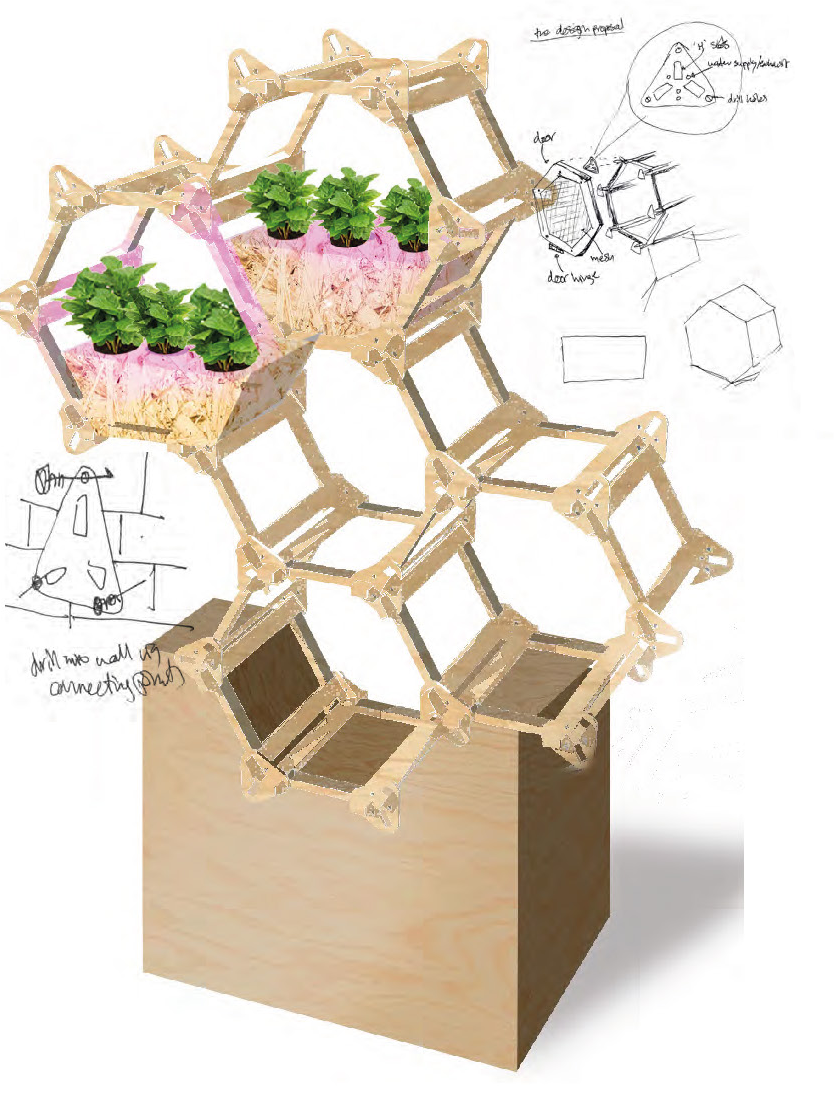
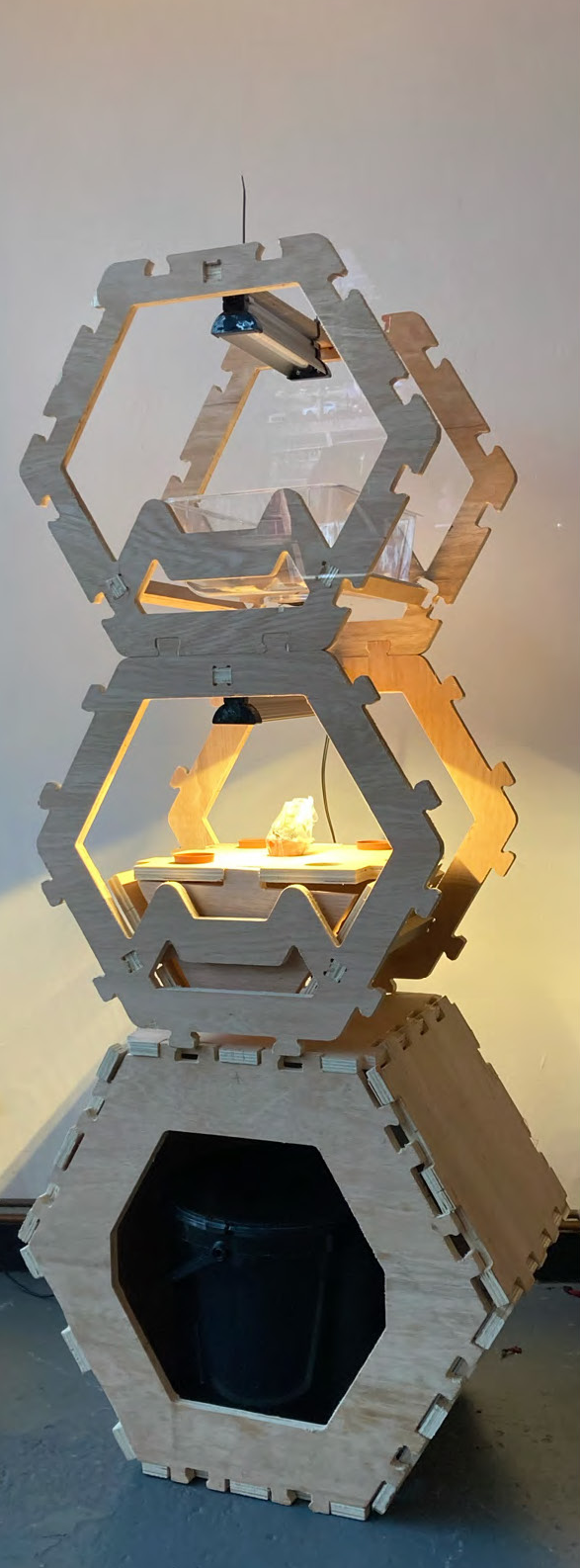
“How can residents claim ownership and be productive in terms of making food? Having spaces where you care and tend to something - and then reap the reward -is fundamental and an important part of what the project is”
“Dealing with a community where there's lots of gentrification happening - any new proposal is met with hostility because they thought we were gonna knock-down their house” continues Teshome.
“But after explaining what the project was about, they came around to ask me. Realising the practicalities, people started to warm up to the idea”
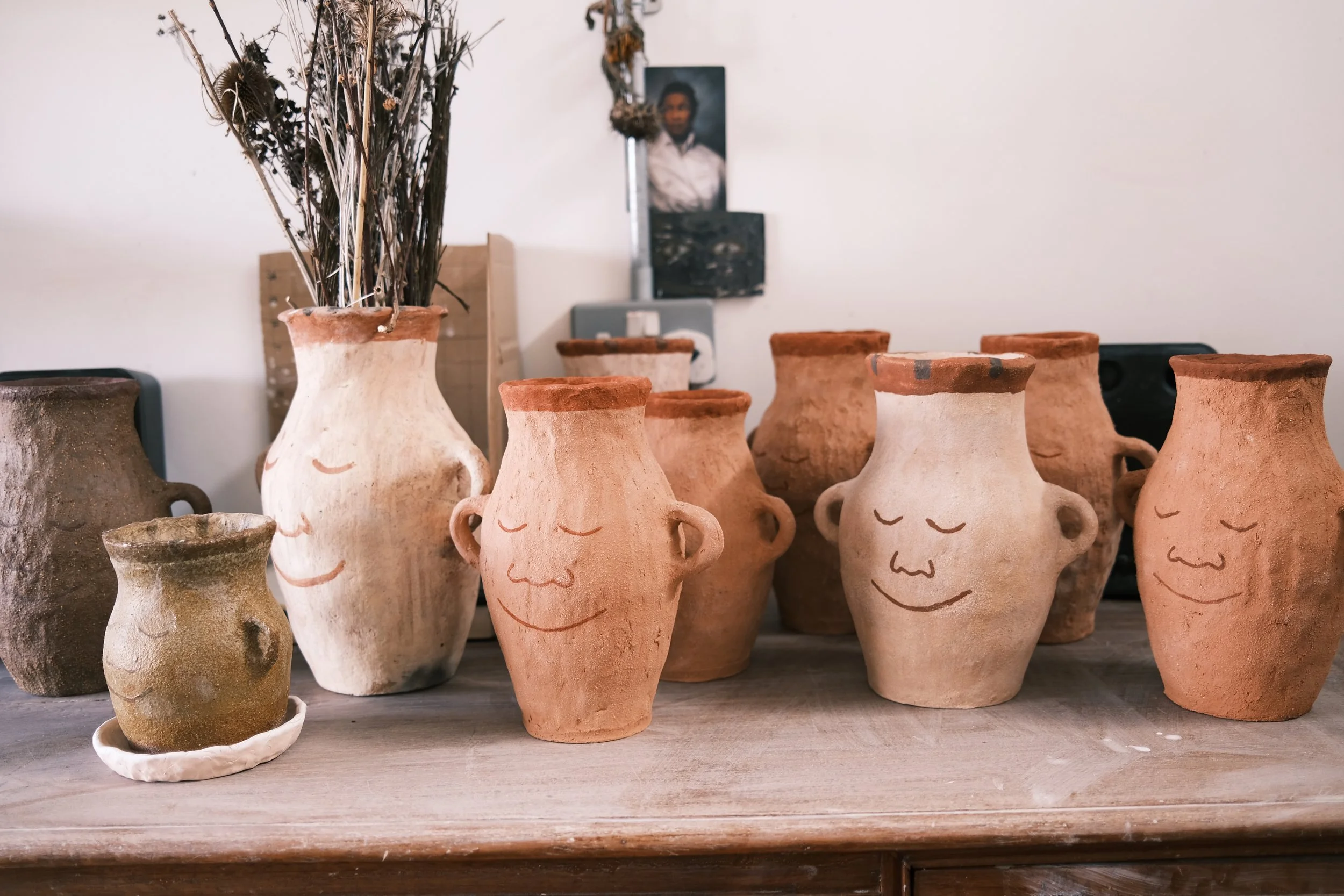
Just as the hydroponic farming modules are vessels for community wellbeing and agricultural diversity, Teshome’s ‘Smiling Pots’ (2024 - present) are a vessel for diasporic representation and a reminder of the holistic, healing history of ceramics.
For Teshome, the ceramic pots “hold energy, and we need to become aware of the function of the energy”. Cupping the pots, the greeting of a smiling ceramic face burgeons affection, and you cannot help but return a smile. The simplicity of the smile demonstrates the power it possesses.
Inspired by the diversity of Pan-African ceramic design, ‘Smiling Pots’ retraces the history of ceramic pots used to store food, beverages, oils, and herbal medicine, appreciated for their craftsmanship, artistry, and storytelling. Teshome builds upon this history, kneading and influencing the clay to embrace the perpetual urgency for care.
Through its non-Eurocentric features, ‘Smiling Pots’ summons wellness and care for ethno-national groups affected by systemic inequalities, ushering the protection of independent, domestic, and communal acts of kindness. By belonging within a space, the vessels hold greater regard for the intentionality behind what inhabits that space and how an ethos of care can be embedded into the furnishings of our homes.
“In general, there are lots of things that are in the service of well-being in diasporic homes. Ritual is strong in a lot of diasporic communities, and that really bleeds through into the domestic space”
“There's always an immigrant dad sleeping on the chair. And the immigrant dad always has his special chair. They have spatial implications about how the family arranges itself in the domestic quarters”
“I think, in these conversations, nothing is any one thing. So it's always exceptional that you might have a diasporic house, which is queer or a home to people with disabilities”
“Democratic movements in domestic spaces are important”
Reflecting upon the direction of his practice, Teshome cites “provocation” and “answers” as oscillating constituents - motioned to constructively shape the future of feminist architecture:
“None of my work aims to give any answers. I don't have any answers to give. But I think it's provocations - putting out provocations in a way which allows discourse”
‘“My approach is to be gentle. I'm very happy to learn and admit when I've maybe changed my mind or been disproved”
“Feminist architecture is a working definition. Especially with intersectional conversations. It's always a moving target. My work is about moving with and influencing what that target is. It's the precarity of architecture. Architecture shifts and changes perspectives over time”
You can learn more about Teshome by visiting his Instagram and official website.
TRIBE Meditation Treatment and Farming for Futures Images Courtesy of Teshome Douglas-Campbell
Studio Images Courtesy of The Poorly Project
