

Edek Thompson
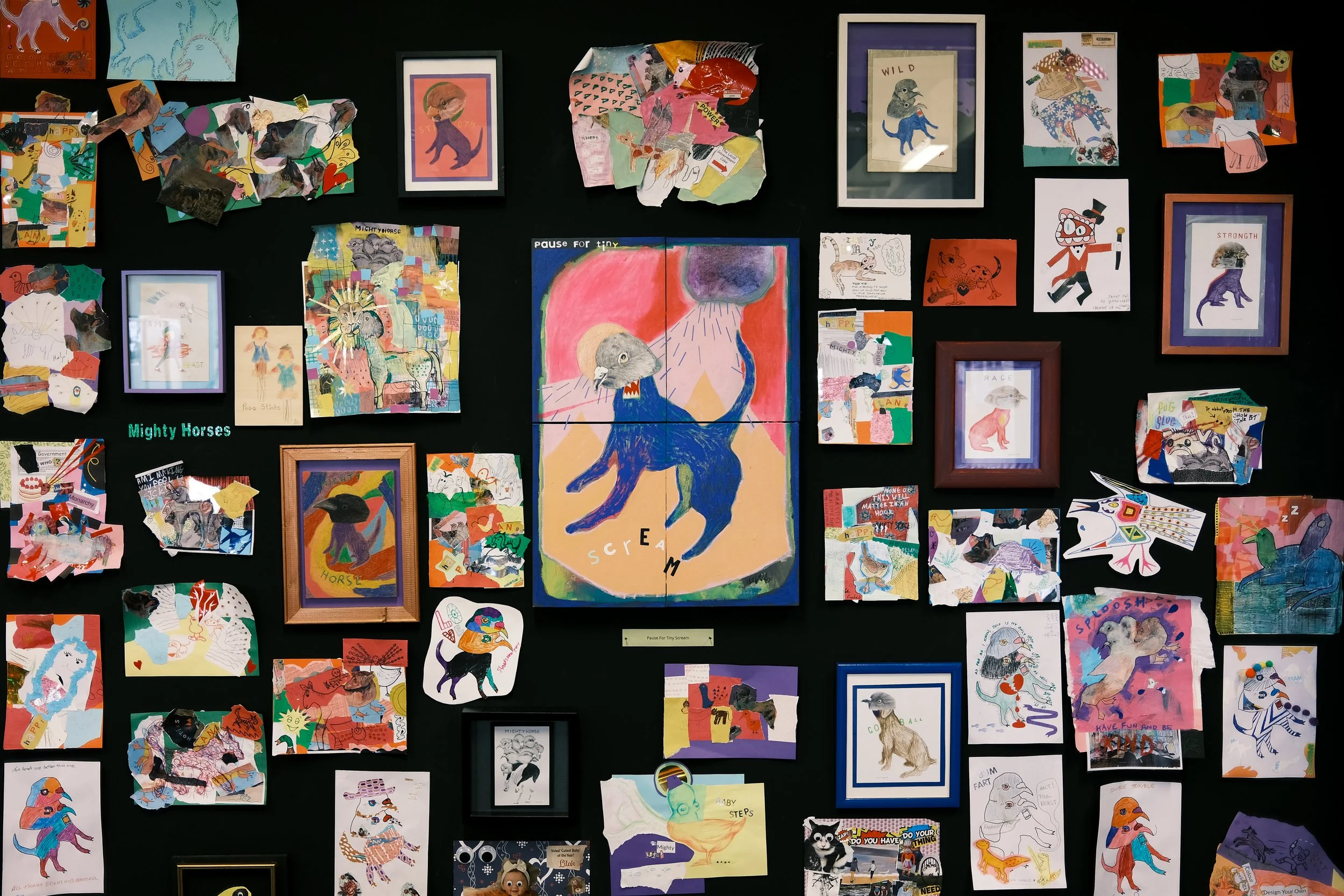
The ecological future and health of planet Earth remain jeopardised by climate change, aggravating eco-grief and anxiety. In response, the artist paints a picture that exists beyond despondent data and alarming articles. A future mythology where, across the scorched terrain, beneath the ruptured craters and against a vermilion sky, a peculiar evolution exists.
Artist Edek Thompson’s creative practice explores this future mythology. Utilising sustainable materials such as leftover paint, advertisement hoardings and emulsions, Edek imagines devastating, apocalyptic landscapes and outlandish, mutated creatures as consequences of climate change.
Together with his apocalyptic vision, Edek purges a personal journey of loss, grief and chronic pain. These themes are intuitively joined to form the mutated, divine overseer that exists across countless illustrations and canvases, known as ‘Mighty Horse’.
Leading Doodle Chat - a Leeds-based, peer-to-peer support group offering community and creative engagement - Edek hosted his exhibition ‘Apocalypse Remix’ at Redcar Palace. The exhibition featured works made by members of Doodle Chat and independent collectives WhichCraft? Ladies and Blooming Youth Collective, who would join the Doodle Chat community.
The Poorly Project ventured to Redcar, North Yorkshire and toured ‘Apocalypse Remix’. Sitting amongst an artistic landmark of community, cataclysm and care, Edek shared details on what it means to be a disabled artist imagining mankind’s comedic, terrestrial finale and encouraging collective laughter at what may come.
Just across Redcar’s coastline and offshore wind turbines is an exhibition that speaks louder than booming surfs and mechanical hums. Finding a home for his exhibition ‘Apocalypse Remix’, artist Edek Thompson greets exhibition-goers, workshop participants and locals at Tees Valley Art’s Redcar Palace.
Sprawling across the venue, attendees are invited into a peaceable exploration of planet Earth’s health and ecological future mythologised by Edek, offering gentle entry to what may appear to be a doomful subject.
Dogs with palmate feet and tricephalous pigeons navigate vibrantly broken-down vistas, uttering misspelt words like ‘strongth’ and ‘protek’. Edek paints a future mythology absent of mankind’s presence, where the mutagenic effects of climate change are apparent and the surviving species memorialise humanity through uncanny murmurs.
In the face of our planet’s strained health, Edek’s creative practice admits to struggles with climate anxiety and the importance of ecological consciousness, yet offers hope through visual playfulness. Through these creative ambitions, an array of what-if scenarios are conceived across various works.
Led by the beholder’s perspective, mutation can be viewed as transfiguration - something sublime and awe-worthy. As we laugh at the creatures propagating Edek’s imagined future, we realise the existence of something, even if it is not entirely recognisable. It reminds us that life may just miraculously persevere.
‘Who Will You Kill For Your King’s Water’ (2026)
“I think people approach it without being guarded. It really helps to start conversations around what climate action could be and the little things that we can do. I talk about community groups as a form of activism and sharing kindness is the best form of activism that we can be doing in any space, because that is something that permeates outwards”
“It is there as the conversation that can be had, and it is there as a way of opening conversations about serious, heavy subjects, but with a lightness to it”
“There's a continuation of life. Hope is becoming something that is creeping more into my work”
Rummaging the corners of his studio and home to find leftover paint, scraps of advertisement hoarding and emulsions, the emphasis on ecological consciousness is layered into the materiality of Edek’s practice. The subsequent consideration is an unbridled sense of play, reaffirmed through the asymmetrical, mixed-media adaptation of a post-apocalyptic land and its inhabitants.
The process of play offers joy to creativity - a principle within Edek’s practice. Heightened with a diverse colorway and resourcefulness, Edek finds his process mutating and adapting, much like the continued introduction of doomsday beasts.
The elements of play and resourceful sustainability are reinforced through Edek’s directorship of Doodle Chat - a peer-to-peer support group working across venues in Leeds. Combating social isolation and supporting community cohesion, Edek leads workshops that offer accessible, low-pressure doodling sessions.
For Edek, the relationship between artist-facilitator and workshop participant is reciprocal. Just as he nurtures a space and offers his practice as visual inspiration, so too does he find himself existing as a treasured member of the Doodle Chat community. Established groups such as the WhichCraft? Ladies and Blooming Youth Collective would participate in multiple workshop sessions, exhibiting their own works within ‘Apocalypse Remix’.
FAR LEFT: Exhibited Work by WhichCraft? Ladies | CENTRE: Edek Thompson’s ‘Tiny Lovely Actions’ (2023) | FAR RIGHT: Exhibited Work by Blooming Youth Collective
“Part of the idea behind Apocalypse Remix is creating a visual manifesto for the community. I call it a ‘visual manifesto’ because it's not about being able to write eloquently. It's about being able to put a message out there to say ‘this is where I live, this is what I want for it’”
“We use the strapline ‘Art builds community, community nurtures hope’ in Doodle Chat, because that's what we start getting, and that hopefulness is the thing that I talk about as refilling me”
“Within the little community groups, you see friendships or a support network forming. If someone is struggling, they can come, share, and other people listen. That starts to build a sense of connectedness, hope and happiness”
The great representative of Doodle Chat’s community is the overwhelming presence of a chimeric entity. With the body of a dog and the head of a pigeon, we are introduced to ‘Mighty Horse’, whose image exists omnipresently within the exhibition. According to Edek’s mythologised future,‘Mighty Horse’ is ‘a post-apocalyptic warrior guardian’, seemingly existing as a singular being and collective. As oppositional factions cross beaks and hooves, Mighty Horse quells the bellicose violence that takes place across the forsaken land.
LEFT: ‘Who Will You Kill For Your King's Water’ (2024) | RIGHT: ‘Who Will You Kill For Your King's Water’ (2024)
After the loss of his brother to cancer, Edek’s ‘Mighty Horse’ came into being during a period of social withdrawal and grief. The uninterrupted, repeated act of illustrating ‘Mighty Horse’ offered protection against emotional collapse. Unlike an unsalvageable apocalyptic wasteland, creativity allowed Edek to till the emotional soil, where a new understanding of grief emerged. Realising the value of ‘Mighty Horse’ during hardship, Edek introduced his creation to Doodle Chat.
“I feel like the weight of grief is a measure of love, and it's important to feel that and understand how heavy that is, and that beautiful relationship that you had before. ‘Mighty Horse’ has become this thing that's crept into all of the artworks and is the conversation starter. For me, it’s a tool for talking, a way of putting words in order”
“I draw ‘Mighty Horse’ at every single Doodle Chat session because that's how I tell the story of what Doodle Chat is and where it came from. That's when people start to understand in the process of what we're doing”
“I'm not drawing ‘Mighty Horse’ to make a picture, I'm drawing ‘Mighty Horse’ to have a conversation with somebody, to get someone else to sit down alongside me and start doing something creative because that's good for your wellbeing. It's good for meeting other people and connecting”
‘Behind This Mask I Could Disappear into The Night, But Brother, That's Not What We Agreed’ (2023)
When grief enters our lives, it becomes something that is sensitively navigated. And much like grief, chronic pain became a subject of careful administration for Edek. ‘Behind This Mask I Could Disappear into The Night, But Brother, That's Not What We Agreed’ (2023) explores the unspoken, mutual agreement between the two brothers: to never concede to suicidal thoughts or ideations caused by chronic pain or illness.
An apocalyptic abstraction of Scarborough Castle’s coastal view, the piece houses a canvas in an inset-tray frame. Hovering far from the frame’s inner base, the canvas vacates space for a stream of pink tears. The peculiar placement complements the odd subjects and disorientating landscape housed within the canvas. As for the source of these tears, they can be found hidden at the canvas’ rear - two eyes belonging to an upside-down, agape mouth. There are no other discernible facial features, leaving only the viewer to insert themselves into the piece and its meaning.
Two Mighty Horses walk across the coastline. The more lofty Mighty Horse possesses a spider plant within its beak. It chirps ‘Strongth’. The small-bodied Mighty Horse stares at its towering brethren. A disc of pastel blue surrounds its face, reminding us of its divine authority.
Side by side, the Mighty Horses speak to the relationship between Edek and his deceased brother. Sharing resilience through the symbolic gift of a spider plant and chanting affirmations, the piece honours Edek’s brother and savours their memories.
LEFT: ‘Rotten Man’ (2026) | CENTRE: ‘Rotten Man’ (2026) | RIGHT: ‘How Do You Choose Who to Hate’ (2025)
“When my brother died a few years ago, we had so many conversations about chronic pain in the build-up to his death. He felt that not so many people could understand the position he was in when he was dying. But he could talk to me about pain because he knew that I understood what it felt like to always be in pain, and the pressure that that puts on you”
“We talk about hope and doing something in anticipation: I need to work out, and so I'm gonna be ready for a flare-up. I'm also gonna be able to pick myself up because I'm putting all these safety measures into place, so I can continue doing my thing”
“I have to think back to watching when my brother was dying. He was a stocky, strong guy, and seeing the emaciated person and understanding the absolute strength in him at the end to not die…you knew there was no coming back from where he was. I never saw someone look stronger than those last few days”
‘Preparations for a Lifetime Underwater’ (2025)
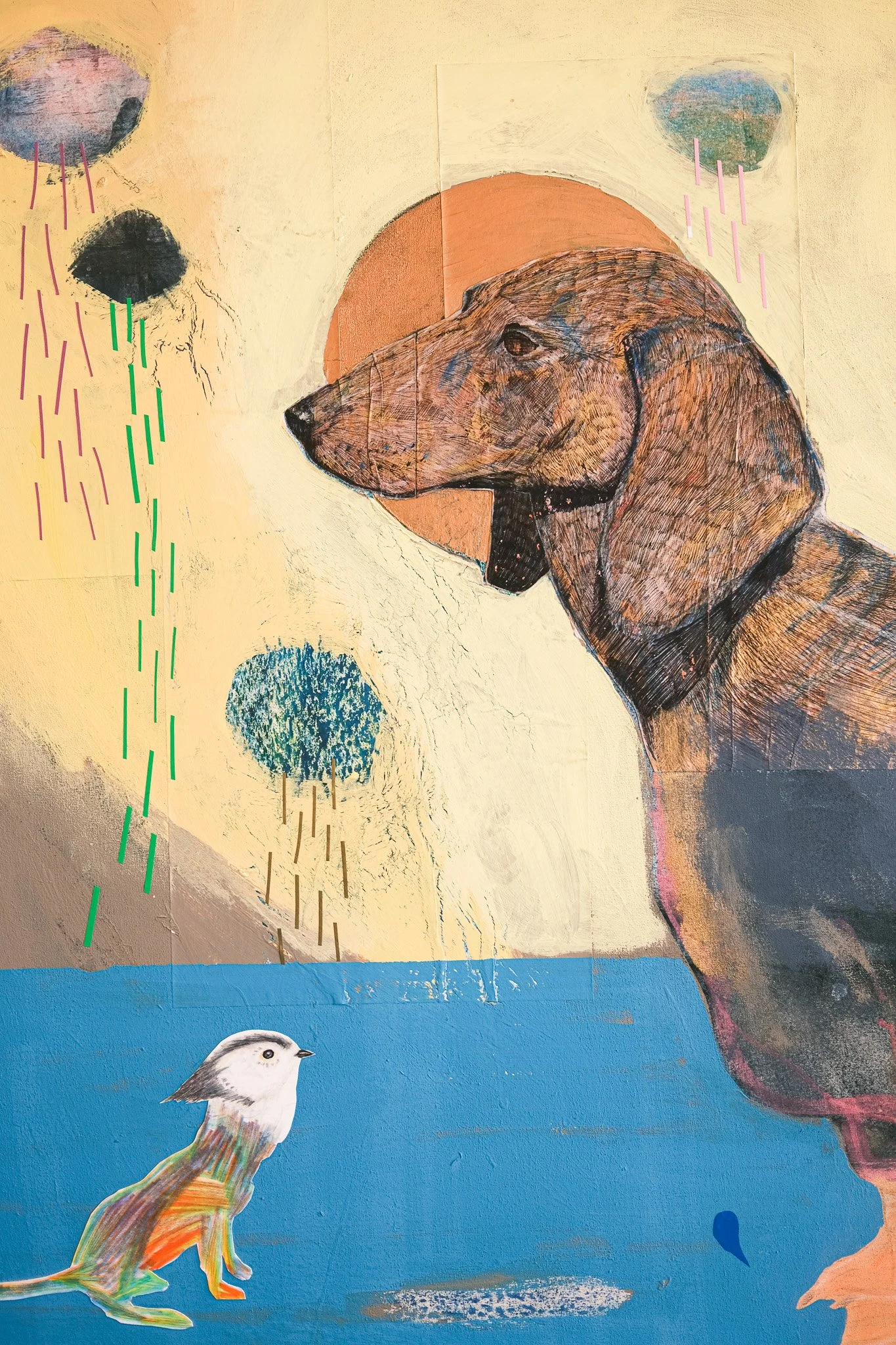
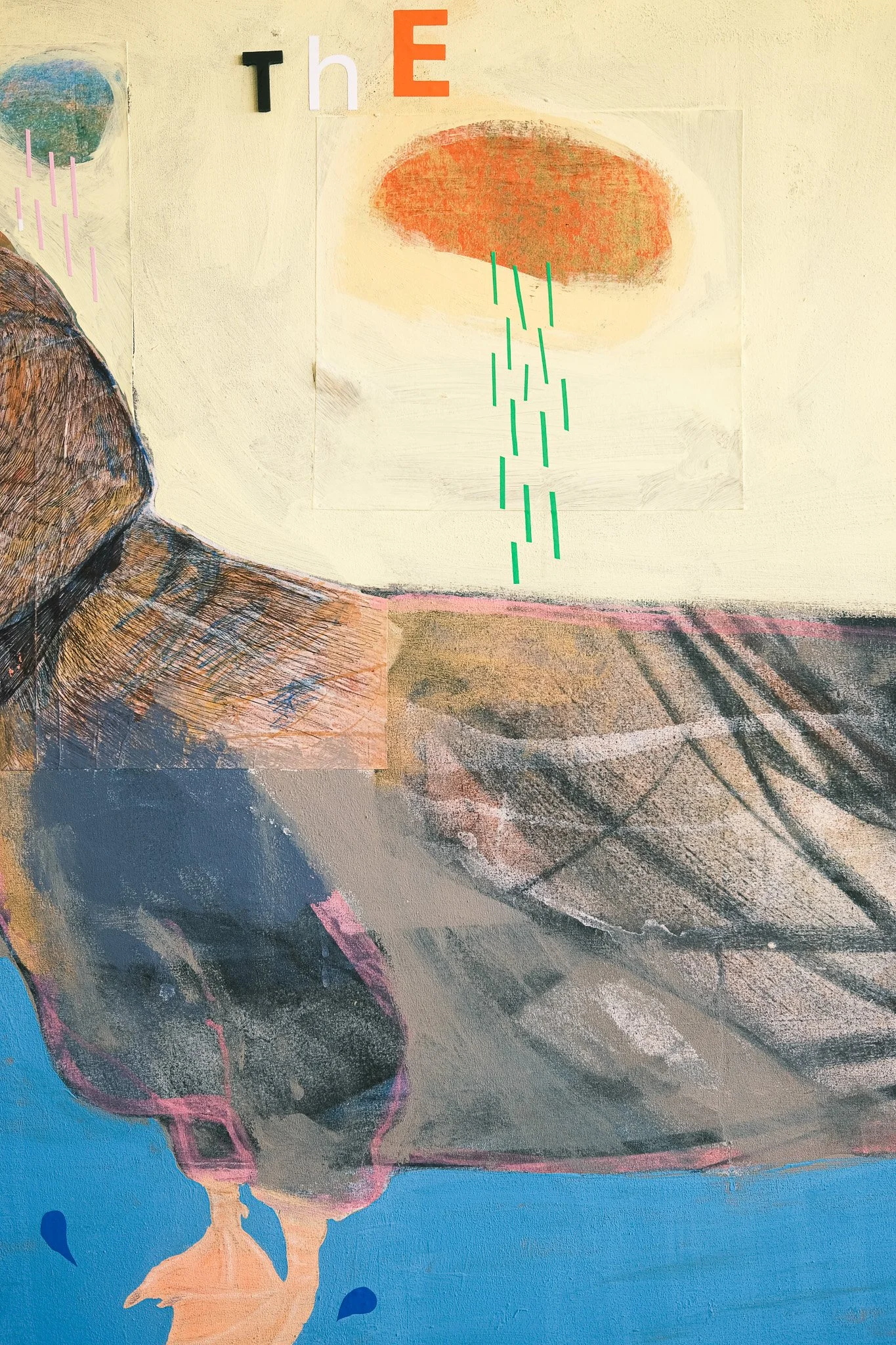
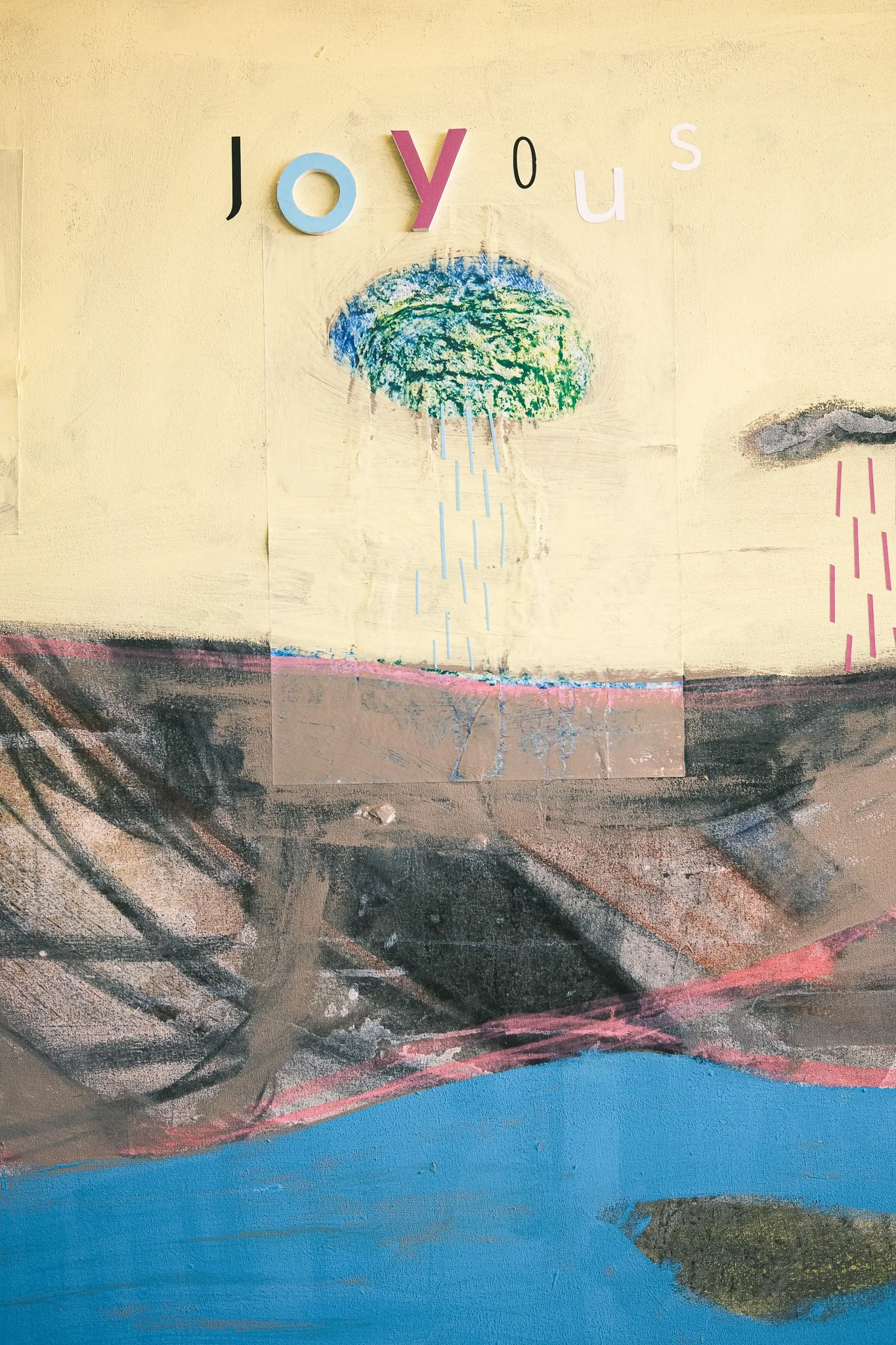
Just as Edek’s practice is led by hope, ‘Preparations for a Lifetime Underwater’ (2025) channels a full societal collapse and ponders a deluge as a chance to reset. Edek admits to nihilism, using the piece as an interrogation of mankind’s capability to do better for the planet and if retribution is severely warranted. Whilst Doodle Chat anchors Edek to the good found within society, the piece more severely points a drowning finger at world powers and public servants.
Plagued rain clouds float across ‘Preparations for a Lifetime Underwater’. With collaborative additions by a Doodle Chat participant, pastels are ground on paper and transferred onto the canvas. Each muddy raincloud pours differently coloured water droplets, suggestive of climate mutation reaching the skies above.
The once sky-born creatures now float with the rising sea, held down by the weight of their mutated lower bodies. A sausage dog dominates the canvas, his paws replaced by palmate feet. The title ‘ The Joyous One’ has been bestowed onto this creature, with a blanket of light pouring in his direction.
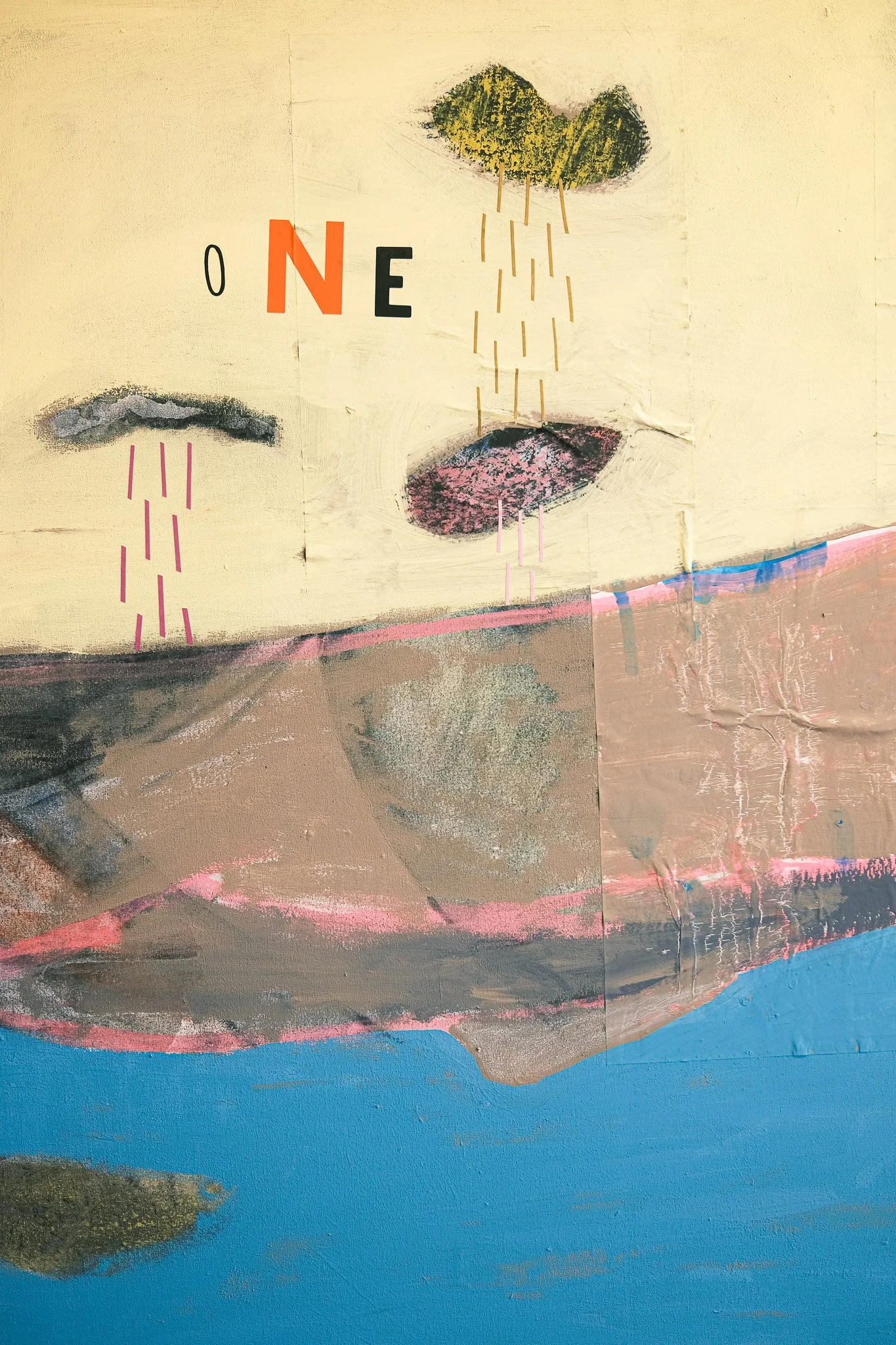
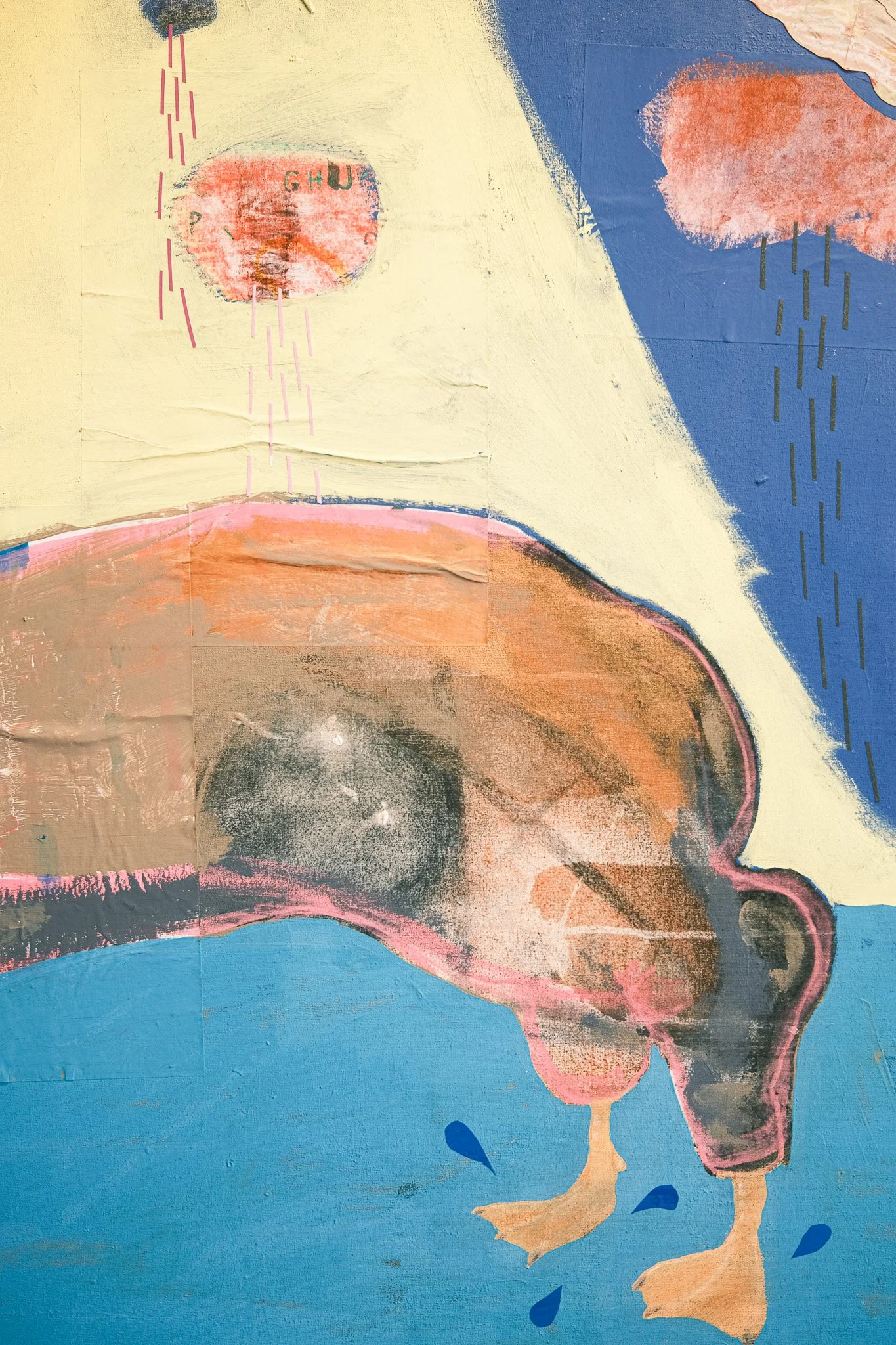
“Sometimes I do think ‘full societal collapse’ and then we can rebuild. It's really hard to change the model we live in now into one that is more considerate of people's lives, their living standards and bringing together communities that are supportive of each other. Getting away from this drive of constantly having more money and greed”
“The painting started with a lot of anger, a great deal of anger. Feeling outraged by things that are going on in the world is a very good catalyst for change. It's a very good catalyst to start looking at the reasons that things are happening and going, “What can we do about this?”
Sitting in contemplation on what collective efforts can be taken to reverse the effects of climate change, The Poorly Project asked what the term ‘poorly’ meant to Edek.
“For me, poorliness is universal. It encompasses all those things that people experience - a feeling of unwellness, and that poorliness that can be something like chronic pain. It can be something like a long-term health condition, it can be mental health, it can be a short-term mishap”
“It is something that impacts my life and impacts what I can do and how I can do it. It's huge, it's debilitating, and it’s changed the course of my life”
All Images Courtesy of The Poorly Project
