

Everyone wants to be loved and understood. Artist Paul Chisholm’s creative sensitivity to these humane exigencies is shaped by his experiences with HIV (Human Immunodeficiency Virus) and Schizophrenia. Developing an emphatic practice that calls out for empathy and socio-cultural confrontation, Paul contests a history of stigmatisation and discrimination, spurred on by social scapegoating and misinformation.
In 2007, Paul received his HIV diagnosis. Trauma would abruptly halt his creative practice and lead him to relocate to Zurich, Switzerland. Following the arduous path to acceptance, several years would pass before Paul’s decision to reapproach the canvas. With warm greetings from advocacy initiatives and opportunities, Paul would find the courage to share his practice and contribute to contemporary discourse around HIV. 13 years later, Paul received his Schizophrenia diagnosis.
In recent years, the hysteria and social pollution surrounding HIV and Schizophrenia has abated. Their indiscriminate nature, altercations on well-being, and life-long management are now better understood. But a distortion remains. Amidst the miasma of falsification and doubt, Paul’s practice is a spirited ode to his lived experience and fervent metamorphosis against the hopelessness evolved from the unexpected.
The Poorly Project visited Paul’s studio to discuss the visual language he imbues into his practice, as he creatively and emotionally navigates HIV and Schizophrenia.
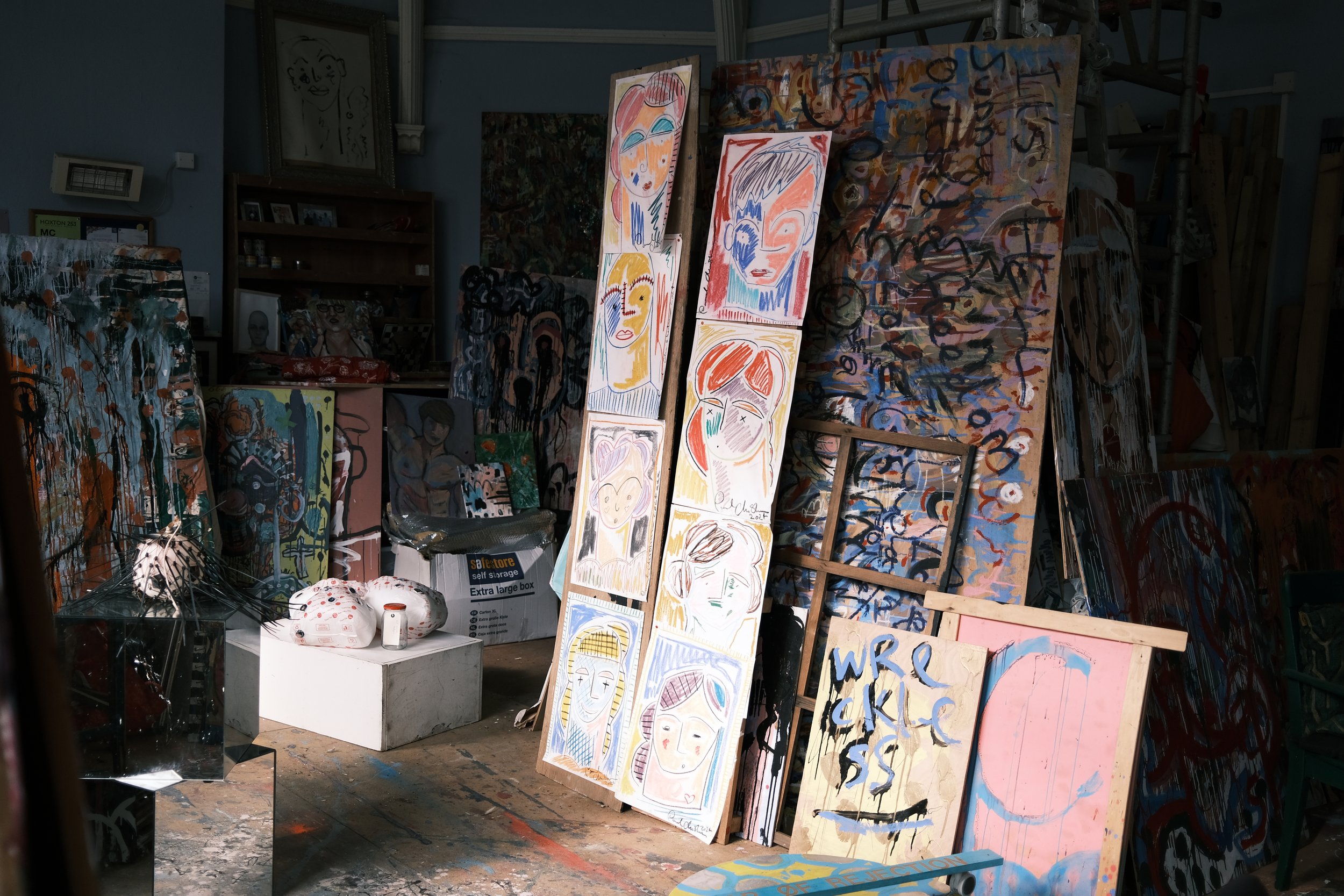
Hidden within the parameters of a local community centre and guided by a cobbled, meandering path stands Paul Chisholm’s studio. Cradled by a dome ceiling rests 15 years of work that reveal Paul’s journey - not only as an artist, but as a homosexual man living with HIV and Schizophrenia.
A journey manifested in canvases stacked upon and behind one another, a symbolic glue keeps the tower of work firmly together. There is a comfort found in this. No work is isolated or exists alone. It is a body of work that, through its open-heartedness, confrontational nature and expanse, forms a defensive stronghold, protecting Paul and withstanding a cannonade of prejudice.
Reflecting the realities of HIV, Paul’s creations speak in earnest whispers and desperate calls; voices to Paul’s soul-searching, grievances and iterative understandings of illness. It is only through the completion of a piece does Paul achieve clarity in understanding its significance, inviting it into his resounding bevy of art.
However, Paul’s diagnostic history with HIV was not one of clarity.
‘Venus in Vondell Park’ (2017)
“It was in 2007, and I was first given the all-clear by the HIV clinic in London. I hence went on holiday to Switzerland to go skiing with my then-partner”
“I got a phone call saying ‘Could you please come into the clinic?’. I said ‘No, I can't. I'm on holiday in Switzerland’”
“Eventually, I got them to admit that I was HIV-positive and that they got the diagnosis wrong. That caused me a lot of trauma. I drank a couple of whiskeys at a bar and felt like jumping off a cliff”
“I would say, my HIV diagnosis definitely took my work in a new direction. It took me a couple of years after the diagnosis to actually start making work again”
‘Fear of Rejection’ (2011)
Stepping back into the creative world and responding vehemently to his diagnosis, Paul would join VisualAIDS - a New York-based international initiative supporting artists living with HIV. He would exhibit ‘Fuck Me I Have…Love & HIV’ (2010) as part of the group exhibition Mixed Messages (2012).
With the title of the piece struck upon a cross, the exclamative, almost enervated expression speaks to the realities of HIV: seeking love and acceptance within the communities you belong to, social pariahism and the sacrifices made in self-disclosure. These conversations are continued in ‘Fear of Rejection’ (2011), reinstating Paul’s past apprehensions that came with disclosing his HIV diagnosis.
The exhibition served as the foundation for rebuilding hope. Paul began to witness the support available, with particular ovation for the Terrence Higgins Trust.
Various works from ‘The Lost Children of Paradise’ series
“I think acceptance was the hardest thing. The hate was easy. That was immediate” comments Paul.
“And that continues to carry on. I hate the fact that I'm HIV-positive. I can't stand it, but it's just something I've had to accept.”
“Now, I've had to learn to love as well. The acceptance comes through things like opportunities - I wouldn't be doing the Terrence Higgins Trust auction every year if it wasn't because of my diagnosis”
With challenges and opportunities sat side by side, controversial takes and misunderstanding sit not too far from Paul’s practice. As Paul’s practice pierces into the realm of art-activism and deeper into the public consciousness, protecting his individual well-being whilst keeping a brush pressed on socio-political matters calls for a great deal of self-assurance.
Intrigued by the acicular cell structure of HIV, Paul would create ‘Viral Load’ (2013) - a pleasure object embellished by glass-headed pins, rendering it into an artefact guaranteed to inflict pain and discomfort. Numerous publications raised the magnifying glass yet failed to inspect closely, christening the piece as ‘The World’s Most Painful Dildo’.
Two portraits created in 2025 for ‘The Lost Children of Paradise’ series
For Paul, the misinterpretation of Viral Load mirrored the misinformation and prejudice held towards HIV:
‘‘I wasn't looking at a voodoo doll. I was looking at the scientific version of what HIV could mean. There have been reflections upon the fact that, because it was a black dildo, it could refer to The Black Death. I'd never thought of that and I found that really fascinating. Ultimately, the piece was a visual representation of the scientific nature of HIV”
In the process of creating work that pricks the public consciousness surrounding HIV, Paul saturates and stretches his work, offering an unadulterated use of colour and scale. It’s a non-hostile takeover, demonstrating the artist’s high-spirited, almost child-like frenzy and enthusiasm for these visual components.
When limited by the scale, Paul’s enthusiasm spills into quantity - ‘The Lost Children of Paradise’ (2018-present) is exemplary of this. An ever-expanding collection of work, Paul has currently painted approximately 160 paintings.
‘Monkey Business’ (2019) from ‘The Lost Children of Paradise’ series
After witnessing a clown during his time in Amsterdam, Paul would gradually discover jesterly faces slinking into his work. Distinct and discoordinated, each portrait reveals the performative masks we wear - consciously and subconsciously - within our daily lives. Each portrait is intentionally exhibited to mimic an unending row of tombstones. With no tokens of remembrance, the admirer is forced to stare downward, grieving their inner child lost to the adult world and the erosion of their mental well-being.
It’s not entirely downcast. Paul manages to find some humour in ‘The Lost Children of Paradise’, comparing it to the popular board game Guess Who?. The admirer is prompted to find themselves within the portraits.
“I think the experience of seeing a clown that was so happy but so sad at the same time - it made me start making these paintings”
“I realised it was the only thing I wanted to paint, or draw. I'd made at least 30 or 40 during my Masters, and then carried on from there. I've been carrying on making them for the last seven years”
“We all put on a mask every day to go out, to go to work, or to go out to the shops. We're all putting on a face - a brave face - to meet the world. That reflects in our mental health, it reflects in our emotions, it reflects in the way that we live our lives. There's not a single one of us that doesn't put on a mask to face the everyday reality that we exist in”
Various works from ‘The Lost Children of Paradise’ series
‘My Magic Mental Illness Superpower’ (2023) sits crisscrossed upon another substantial stack of paintings. With its form mimicking the unravelled lobes of the brain, rainbow-striped appendages are representative of Paul’s choice to rearrange his understanding of Schizophrenia - admitting to its challenges, yet committing to the possibility of his mental health condition serving as a begetter of empowerment and empathy.
Depending on which rendition you witness, jammy dodgers, nazar amulets, prismatic rainbows, emojis or the word ‘joy’ can be found badged along the many bodies of ‘My Magic Mental Illness Superpower’. They are emblems of Paul’s playfulness, self-preservation, homosexuality and request for joy. In the fickleness of joy, ‘My Magic Mental Illness Superpower’ establishes empathy as a caped hero wielding irrepressible creative expression - strained, strengthened and evolved out of necessity.
Beyond the phantom sounds of his Schizophrenia, the soft, variegated body of ‘My Magic Mental Illness Superpower’ gently reminds Paul to practice self-empathy, walking him through the path he has travelled and pointing out the barricades he has pushed past. It reminds him of how self-consolation was subdued by engaging with his practice, burgeoning creative wholeness.
Various works from ‘The Lost Children of Paradise’ (2018-present) series & ‘My Magic Mental Illness Superpower’ (2023)
When asked about the significance of the term ‘poorly’, Paul’s response emanates hope and gratitude - not only for the support he has received throughout the years but for the wonders of his own perseverance, aided by artistry and the prospect of something better:
“I think poorly means having a diagnosis which you never wished for, you never wanted. But it also means being poorly enough to be able to answer the tale. I think I'm lucky and I give gratitude to God that I'm actually here to be able to tell my tale.
“At some point, I didn't think I was going to push through or be able to make more work or do such a great opportunity like today. So yeah, I'm really grateful for your time. Thank you”
You can learn more about Paul by visiting his Instagram and official website.
All Images Courtesy of The Poorly Project
